Why The World Bank Really Sucks. (IMF, too.)

Leave a comment
Essays

lI enjoyed this Foreign Policy Magazine piece offering a contrarian perspective on Africa’s growth over the last 10 decades. It describes TIME magazine and The Economist’s cover story articles about Africa’s precipitous rise. As author Rick Rowden says of these magazines,

They looked to Africa’s recent high GDP growth rates, rising per capita incomes, and the explosive growth of mobile phones and mobile phone banking as evidence that Africa is “developing.” Rich countries figured out long ago, if economies are not moving out of dead-end activities that only provide diminishing returns over time (primary agriculture and extractive activites such as mining, logging, and fisheries) and into activities that provide increasing returns over time (manufacturing and services), then you can’t really say they are developing.

Indeed, simple free-trade isn’t sufficient criteria for real, sustained growth. Mining and agriculture alone will slow down, once you’ve reached peak levels of your natural resources. Industrialization, which is the sustainable and effective way to become a rich country, requires speculative investment (from governments AND from private investors, as Bill Janeway eloquently describes in this fantastic book) and especially creating a knowledge worker class who can produce competitive advanced goods to sell in an export economy and as price-protected services to their population.

Now, imagine if the entire continent of Africa were to invest in huge domestic stimuli the way China has, and use currency protections and price-fixing to artificially manufacture the ideal high-growth conditions that would fast-track the continent to industrialization. The global iron, diamond, oil, gold industries would be thrown into the type of chaos that we saw with the OPEC crisis of 1973. Ghana, Angola, Chad, Botswana, Nigeria, and DRC would suddenly be globally influential because of their control of their own spigots of valuable resources**. Their education systems, manufacturing industries, and entreprneurial communities would explode. But, of course, the World Bank would never allow such.

The World Bank, after all, is the very same organization that was constituted to rebuild Europe after World War II. A Europe that was, mind you, made up of England, France, but also their two dozen African colonies. While the organization’s mission, goals, and processes have evolved, it is still an organization whose function is to keep the global economy stable, and is overwhelmingly funded by the United States and other rich western countries. Under these circumstances, the global economy is stable if developing countries don’t grow too fast (inflation), or take on debt that they might not be able to repay (sound familiar?). These developing countries are strictly discouraged from expensive national stimulus programs, no matter what their domestic needs are. In so many cases, their ministers of finance are educated in the US, the UK, or France, and have done a stint of their formative years at the World Bank. The World Bank gives low-interest (and sometimes zero-interest) loans to developing countries, ostensibly to raise them up. But really, it just keeps them down. And it’s unfair.

**The counterargument that political stability or open democracy, is the far bigger obstacle facing Africa’s permanent rise is interesting, but I think tangential. The Middle East is an interesting case-study there.

I can’t deal today.

Leave a comment
Essays

Within 10 minutes of stepping onto the streets of SOMA, a young bearded man who couldn’t have been older than 35 started trailing me, screaming “you black fuck! Turn around. I’m talking to you, dirty nigger.” I turned to face him, and said, “I’d prefer you say that to my face, like a man,” at which point he did say it to my face like a man. If there wasn’t a security guard at the corner, I don’t even know. And then I walk into a coffee shop, where a dozen comfortably dressed white people are politely, quietly sipping their coffee, talking about valuations and haircuts. Of course, the other black man in there was old, bearded, and very homeless. He zeroed in on me, bee-lined it over, and began to tug at my jacket insistently. I took off my headphones, and he was asking aggressively, insistently, noisily, for some money. I asked him to step outside, and gave him a few bucks. I asked him to be polite, and not bother people inside stores, because that’s how people get arrested. I walked back in to a disapproving half-shake from the barista, a room of studiously avoiding gazes, and hip-hop quietly playing over the sound system. And, of course, when I sit down with my espresso and pull out my Karma* to hop online, two people recognize me from tech, and we proceed to geek out over sharing mobile data, and how much better all this exciting collaboration software will make the world.

*Where we are an investor.

Working on the right problems.

Leave a comment
Essays

I loved this New York Times article about the “busy” problem.

If you live in America in the 21st century you’ve probably had to listen to a lot of people tell you how busy they are. It’s become the default response when you ask anyone how they’re doing: “Busy!” “So busy.” “Crazy busy.” It is, pretty obviously, a boast disguised as a complaint. And the stock response is a kind of congratulation: “That’s a good problem to have,” or “Better than the opposite”

As I step into the New Year, I’m eager to be mindful of its conclusions, and to draw a few of my own. I was crazy busy last year, especially in the second half of the year. I was working on a few problems that were personally interesting to me, and meeting with start-up companies constantly. I had pitch meetings, casual meetings, phone appointments, to-do lists way too long, and was always doing five things at once. I got enough done, but there were a lot of hanging chads, and it was frustrating.

In designing software, developers will tell you that one of the most important and fundamental truths of programming is to design a program that gets from A to B most efficiently. Knowing when to use a stack, push, or pop method for a list of items is the difference between having to unload/reload the list each time in a loop and just getting the object you need right when you need it. Understanding the power of recursion instead of a regular iterative loop can save you memory, complication, and (crucially) lines of code. Efficiency is elegance.

Developers will also tell you that they need blocks of time to write code, and that it’s not always, or necessarily, 9-5. They know to abhor useless meetings, and they instinctively put a high premium on the power of concentration. We should apply that instinct to everything that we do. Back in the days of One Block Off the Grid and Virgance, our Chairman Steve used to speak a lot about how the hard part of work was knowing which problem to work on. Too often we’re working hard, but not on the right problems. Goodbye to all that. I hope to do less this year, because I want to do more. I have separated my work and personal email, taken email entirely off my phone, and will try and spend at least a half day, if not a full day, a week off the internet entirely to focus on writing, reading, and creative thinking. I’m working on much fewer projects (more on that later), and staying patient and purposeful with my work.

The times in my life when I’ve committed to single-tasking are the ones when I’ve been the most productive, the healthiest, and the most in-tune with my goals. Single-tasking requires the space for reflection, so that we can arrange our priorities and our skills against the insane amount of information we take in every day. So I’ll be taking more time this year. Join me!

On service.

Leave a comment
Essays

As the year draws to a close, it’s time for resolutions and reflections. Mine has to do with service. These questions about service have been hanging over me a lot this year, and I would like to share some of my explorations on this forum.**

What does it mean to serve?
“To help those in need.”

That sounds good, right? It seems to encompass volunteering and economic development and political activism, all usually associated with service. But if I’m a relatively poor young person helping a rich old man with his taxes, is that service? What if I’m a depressed and lonely person volunteering at a soup kitchen, serving a close, loving, homeless family? Which of us is in need, there? Who is doing the serving, and who is being served? In obvious ways, we are all in need. So is service then all thoughtful interactions between two people? That feels too big, too easy.

Some of my more morally attentive friends define service in terms of motivations. They find themselves discomfited when community service is only done for college applications; when community members publicly tithe to keep up with the Joneses; when peers visit South Asian orphanages to make themselves feel good (and look good on Instagram); when colleagues ask for charity:water donations for their birthday, to increase their Twitter following. According to the logic, if volunteering and development and activism make me feel good about myself, primarily, there is surely some twisted lack of regard for those in need. They suggest that service should have a certain motivational characteristic – one of proper altruism – for it to be the ‘right’ kind of service. Assuming altruism is possible, is selfless motivation the only circumstance for service? Is wanting to feel good about myself on Christmas the wrong reason to spend it at a soup kitchen?

The etymology of the word “serve” comes from the Latin servus, which means ‘slave’. A slave is someone who works for no pay, or nothing in return. So perhaps the altruism – expecting nothing in return – is indeed the ‘right’ kind of service. But that feels too hard.

Why do we serve?
Thomas Aquinas, the famous Christian theologian, says we serve (do charity) as a way to spiritual happiness. It is one of the virtues, and it is an act of friendship not between the giver and the recipient, but between the giver and God. Jesus says, after all, that to “love thy neighbor” is, along with “love God”, the greatest of the commandments. The third pillar of Islam, zakat, proclaims mandatory almsgiving, or charity, and is well-documented in the Koran, and other hadith law. Maimonides, the famous medieval Torah scholar, describes tzedakah as a necessary religious obligation for faithful Jews. Buddhism and Hinduism affirm almsgiving as a way of practicing virtue. As an act of faith, service seems necessarily self-directed. But there’s a problem here. After all, the most morally attentive of us intuitively dismiss selfishly-motivated service. So surely the purpose isn’t just to make oneself better.

Some of the wonkier among my friends and colleagues judge service according to the market. According to them, the sum of transaction-based actions we can take (where I give something in exchange for receiving something equivalent) insufficiently meets the complex and evolving demands of society. In other words: markets are inherently imperfect. Service is what makes up the difference. Service brings us to social equilibrium. This argument works from a few political angles. On the activist left: that’s why we need government and NGO’s. We must pay taxes and support non-profit to help those who can’t help themselves. On the religious right: government-edited markets are imperfect. Give people back their money; encourage them to fill the gaps through local churches (mosques, synagogues, temples, etc). But it’s still massively wide-scope. Paul Ryan and Barack Obama might both agree here, but on none of the implementation.

(I wonder what libertarians think.)

What makes for effective service?
On implementation, how do we measure service?

Consequentialists measure it with math: how many wells built, how many shoes donated, how many dollars loaned (and repaid), how much world food redistributed. This is supremely hard. First, macroeconomics is impossibly abtruse. Unified theory about how to improve people’s lives at scale is like string theory. It must exist, but god knows how we’ll find it. I’ve heard eloquent arguments about TOMS shoes fucking up local economies by overwhelming the supply and pricing out local shoemakers. I’ve heard elegant concerns about the World Bank holding back emerging market development, because the stipulations around low-income loans preclude debt-fueled stimulus in recipient countries. Stiglitz and Sachs can’t both be right, but they both are, in layman’s discourse.
Second, the math is so complex. If I spend an hour at a soup kitchen feeding the homeless, am I making the world better? Would that hour not have been better spent working for affordable housing legislation, so that thousands of homeless could have homes, rather than hundreds of homeless having one meal?

“Bang for you buck” service gets confusing quick.

Others just choose one metric of human achievement, and are zealots in tracking it. If I choose “life expectancy”, then surely I’m winning, right? And what about GDP per capita? It’s a fact that the world is getting healthier, so the world is getting better, right? People who think this way can rationalize pretty much any economic action as a public good. I’m not one of these people.

And if I’m not a consequentialist, then is Aquinas right? Is service most effective when it makes us all holy? I’m into that, in theory. But in practice, humility seems harder to grasp when I’m only trying to ready myself for Heaven. Is service most effective when we are all just helpful with no expectation of reward? That sounds pretty good, but pretty damn idealistic.

So what am I?
Gosh, I dunno. It’s complicated: I am at any moment all of these things. But, I admit, I am too often none of these things. My resolution is the same as it was last year, and probably will be next year: to serve more.

What about you?

**Martha Muña, Alex Magnin, Tania Mitchell, Tom Dougherty, Robert Reich, Will Kymlicka, Immanuel Kant, and John Stuart Mill all deserve thanks for keeping this top of mind for me this year.
Is Consumer Software all Social Media?

Leave a comment
Essays

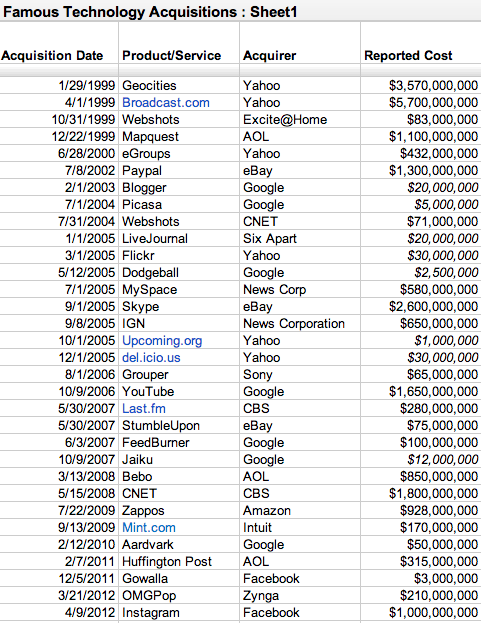
I used to hear people talk about consumer software and social media interchangeably. I always used to think of these people as luddites or not in the loop somehow. I believed that this mistake was largely because social media is viral, is where people communicate, and is noisy. After all, consumer software is surely far more than new media. But lately I’ve been trying to understand what it is, with the intention of better understanding our thesis about collaboration, innovation, and web-powered value creation. As part of this exercise, I took some time to look at big U.S.-based acquisitions over the last dozen years. Here are some statistics I found which are interesting*:

image

I decided to categorize the start-ups by “News”, “Communication Tools”, “Photo/Video”, “Music”, and “Other”. Based on this categorization, the lion’s share of acquisitions have been communication tools (8) and photo/video sites (8). There have been 4 news sites, 1 music site, and the rest have been ‘Other’. In the last fifteen years, 2/3 of the consumer software acquisitions have been “Social media”, by one definition or another, totaling over $20B**. Even today, Reddit, Tumblr, Quora, and Twitter demand a lot of our attention. It’s worth considering the fact that those people who use consumer software and social media interchangeably aren’t crazy or wrong.

At least, not yet.

This article describes which start-up companies today are most popular to developers on AngelList, which is fast becoming a powerful resource for the early-stage funding, research, and recruiting. The companies are: Quora, Pocket, Path, Pulse, ClassDojo, Instameet, Ark, Rally, Locu, Clever, 42Floors, Kaggle, Ouya, Skillshare, WikiHow. Of these fifteen, 6 are “social media”, 3 are education, 2 are productivity, 1 is hardware, 1 is recruiting, 1 is non-profit fundraising.***

It makes me wonder if the next 15 years will resemble the previous, or if we’ve finally reached the point where the best businesses are not simply social media, but innovating on the rest of the web. I was frankly surprised by how many social media acquisitions there were in consumer, as compared to other categories. Now this list does not include eBay, Amazon, Google, Facebook, LinkedIn, Groupon, or Zynga, all of whom are now public companies, representing a greater diversity of industries. Perhaps software is finally eating the world, after all.

*(rumored prices are italicized)
**In 2007 alone, just three enterprise software companies were bought for a combined $10B. Needless to say, enterprise rules.
***We invested in Rally and Skillshare. 

Is Facebook a consumer company?

Leave a comment
Essays

What defines a consumer company, anyway? My working definition was a company which had you and me, individuals, as their customers. Samsung is a consumer company. I buy phones, washing machines, flat screens. Unilever is a consumer company. I buy ice cream, shampoo, and tea. Microsoft is a consumer company. I buy word processing, operating systems, and video game consoles. These companies are made or broken by how many products they can sell me. 

What do I buy on Facebook? Yes, Zynga sells me (well, *somebody*) all sorts of digital goods within their games. And yes, Facebook does sell credits on the side. But 85% of their revenue comes from advertising. They sell advertising to companies: their customers are enterprises. Are these ad-revenue digital platforms really consumer companies? We are their product, not their customer, after all.

Crowdfunding Under The Best Investment Terms

Leave a comment
Essays

The cheapest possible investment a company can get: customers paying more for the product than it cost to build the product. This throws off the cash to grow, keeps equity intact, and avoids accrual of interest. Happiness is positive cash flow. How do we apply that to equity crowdfunding, the new wave of private financing marketplaces. Today, people who are concerned about equity crowdfunding point to two major problems:

– If your equity crowdfunding platform is aimed at high-growth startups who are meant to return multiples, you run a very serious risk of losing everybody’s money all the time. Venture investing is a hard business that doesn’t return well, even for professionals. There’s no evidence that the crowd will invest any more wisely. Plenty of people believe that they won’t.

– If your equity crowdfunding platform features lifestyle business, what’s the payout, or return on investment? Just administering the dividends alone might cost more than the actual profit margins. Bars and coffee shops don’t make enough money to pay lots of people out. And if they do, if it’s only a dollar a month over 20 years, I don’t know if I’m that excited, as an investor.

One interesting feature that has emerged from Kickstarter getting to scale is this phenomenon of “pre-sales” for gadgets. In this model, the business start-up costs are paid for by customers waiting for their product, thereby charging future customers for current costs, but transparently and (more) ethically.** What about pre-sales for beers, or coffees? What if I raised a quarter million dollars of start-up capital for a restaurant by giving every ‘investor’ a free meal, or free set of meals, assuming an appropriate markup for COGS and operations? I’m giving my investors a return that they care about, I’m guaranteeing a certain amount of customers from day one, and I’m raising start-up capital without giving up any equity or paying any interest. Does the math work? What do you think?

** There’s still a risk that the company wont fill the orders and go under. Kickstarter gadget projects are feeling the burn here. But there’s always risk in investing, and this is a more easily mitigated risk than most, given the stage.

What We Can Learn from Airlines About Product-Market Fit

Leave a comment
Essays

The airline industry is a useful case study on product / market fit. There are infinite features airlines can provide, and there are as wide a range of plane travelers as one could imagine. Virgin America, Spirit Airlines, and Southwest are three good examples.

Virgin America has consistent WiFi, plays nightclub music and has sexy mood lighting. Anecdotally, the tech community reports on experiences flying Virgin America far more than other airlines. Customers love it. In fact, Virgin America has won more awards since their founding than any American airline. But TIME magazine recently reported that

since 2007, Virgin America has posted a net loss of $671 million and an operating loss of $446 million.

Nobody likes Spirit Airlines. They are cheap. They nickel-and-dime at every possible turn, and offer a stripped down version of travel that feels a little bit like a Chinatown bus in the air. Their flights are consistently the cheapest at face value, but they offer very little personality, or charm, and hide fees down to charging for water on their flights. They are the anti-Virgin America. And they are killing it. According to Wall Street Journal, they are 

pound for pound, the most profitable airline in the U.S.

All bags fly free on Southwest. Unlike Delta or United, Southwest prefers point-to-point flights, so you don’t have to connect in Charlotte, or Atlanta, to get where you want to go. Southwest does not have WiFi, and they have first-come first-served seating, like a bus or train. Their goal seems to be less about maximizing profits, like Spirit. They don’t want to coddle their customers, like Virgin. They seem to care most about what the customers want – cheapest possible travel. And in an industry that has been losing money for a half century, Southwest has been profitable for 39 consecutive years.

I went to the corporate websites of these three airlines to try and learn a bit more about why each of them has chosen the path that they’ve chosen. I found “About Us” pages that could not have been more different, and even surprising.

On Virgin, unsurprisingly, they list their amenities and awards:


On Spirit, they describe their “ultra low fares” and “fee-based” optional upgrades:

But on Southwest, they describe a mission and set of values:

Each of these airlines is winning in a big way against its competitors because of how they have built their feature set. Nobody can touch Virgin’s experience. Spirit’s profits are the envy of the whole industry. Southwest has a no-nonsense transparent experience. But I’m struck by how the airlines think of themselves, and that’s where I think the real lesson lies. If you are looking to build a business to last you a long time, you need to do more than listen to your customers, or to your shareholders, like Virgin and Spirit. You need a mission that makes sense, and the discipline to build your business outward from it.

Financing the Ed-tech revolution

Leave a comment
Essays

I met two companies this week who are working on solutions in a space that I had only considered in passing until I spoke to them. Per U.S. household, there is currently more student loan debt than credit card debt. We’re talking, ballpark, one trillion dollars. And that number doesn’t seem to be going down any time soon. The cost of college has risen 1,000% since they started keeping a record of the figure in 1978. For some context, since 1978 the cost of food and healthcare have risen 200% and 600% respectively. Education costs are blowing up. Recession-driven state budget cuts are sending public education costs through the roof. For-profit universities are greedy bastards, and private universities have always been expensive.

And it’s not like the market is not trying to solve this problem. In the United States alone, $100 billion of grants and scholarships were distributed last year from 20 million sources. And the government is trying its best to support the markets, and their efforts are (to my understanding) impotent. The Obama Administration approved a $40 billion increase in education spending to address this crisis. The landmark result of this legislation raises the limit of a Pell Grant by… wait for it… $400. By 2020, they expect another 820,000 students to receive the $6000 promised by the grant. It’s an earnest (and expensive) effort which I applaud, but it’s not gonna do much. One thing’s clear: this market needs technology.

Thanks to Learnsprout and Clever, there are now API’s across school information systems – which are the fragmented data management tools that all schools nationwide use – so innovators can build apps that use attendance, grades, and all other individual, school, and district data to improve outcomes in K12 education. These APIs should power innovation in higher-education financing as well. It should be easier for schools to discover scholarships and grants for their top performers, it should be easier for those performers to apply for the optimal number of scholarships (which is probably many more than the average student applies for), and grant-makers should take advantage of this unprecedented access to school data. Crowdfinance can grow the pool of capital accessible to our students by inviting the community to participate. Consumer web/mobile applications can simplify the process of tracking and repaying loans for students. The numbers in this market are absolutely massive. There’s money to be made, and a lot of good to be done. While we talk about MOOCs, other forms of vocational training, and re-education, we should consider innovating on college financing. Some folks are already doing what I’ve mentioned above. Let’s see more!