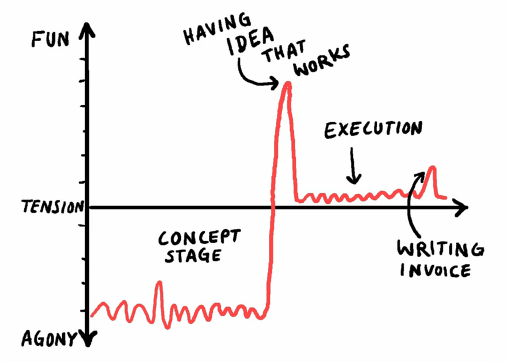
From the phenomenal Christoph Niemann at CreativeMornings/NewYork
The Design Process by Christoph Niemann
Perfect.
From the phenomenal Christoph Niemann at CreativeMornings/NewYork
The Design Process by Christoph Niemann
Perfect.
Over the past 10 years, technological advances dramatically lowered the financial bar for starting a new company, but the courage bar for building a great company remains as high as it has ever been.
3 guys, 44 days, 11 countries, 18 flights, 38 thousand miles, an exploding volcano, 2 cameras and almost a terabyte of footage… all to turn 3 ambitious linear concepts based on movement, learning and food ….into 3 beautiful and hopefully compelling short films…..
= a trip of a lifetime.
move, eat, learn
Have you seen, anywhere, in any media, or even heard reported or repeated on NPR, the following sentence?
“We have changed our assumption on this because the majority of Republicans in Congress continue to resist any measure that would raise revenues, a position we believe Congress reinforced by passing the act.”
It’s right there on Page 4 of the official Standard & Poor’s ”Research Update” — the actual report on what they did and why — published on August 5th as the explanation for why they believe Congress — and even the Gang of Twelve — will be unable to actually deal with the US debt crisis. Perhaps it’s just lazy — the bullet points at the beginning of the report don’t mention the Republicans or taxes, but instead just say, for example (part of one of six quick bullet-points):
“[T]he downgrade reflects our view that the effectiveness, stability, and predictability of American policymaking and political institutions have weakened at a time of ongoing fiscal and economic challenges”
In order to figure out that one of the reasons why is that “Republicans in the Congress continue to resist any measure that would raise revenues,” a hard-working reporter would have to read to page four of the eight-page report.
It’s just too much effort for most reporters?
Although they do also mention this in the very first sentence of the report: “We lowered our long-term rating on the U.S. because we believe that the prolonged controversy over raising the statutory debt ceiling and the related fiscal policy debate indicate that further near-term progress containing the growth in public spending, especially on entitlements, or on reaching an agreement on raising revenues is less likely than we previously assumed and will remain a contentious and fitful process.” (Italics mine)
Or could it be that many reporters — and virtually all of the television talking heads — are themselves relatively high income-earners who don’t relish the idea of higher taxes?
Or could it be that reporters are afraid that if they report the actual language of the S&P Research Report, then Republicans will punish them by denying them “access” — i.e. refusing to show up on their programs — which is the career and show kiss-of-death for radio and TV programs that rely on big-name politicians to work?
I don’t know the reason, but it’s fascinating to see all the huffing and puffing about the S&P downgrade of America’s debt that all seems to be working so hard to avoid mentioning that critical sentence.
Inquiring minds want to know”
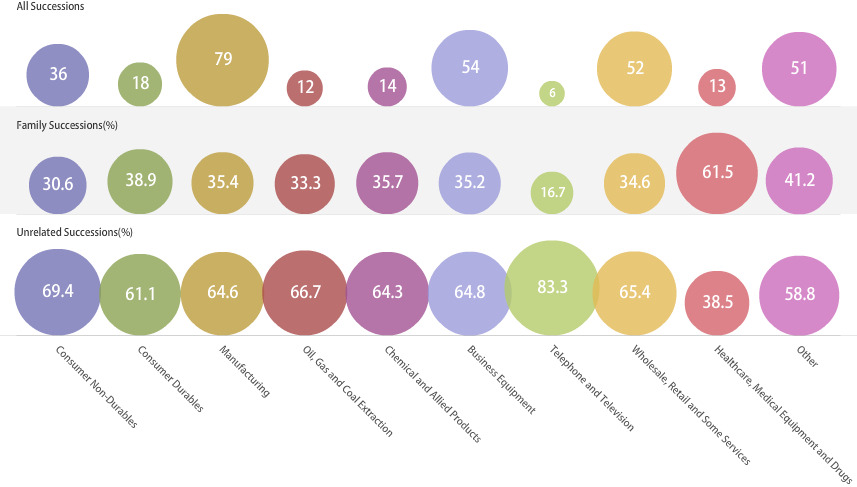
What’s the difference in performance between a family business where the CEO hands off leadership to a member of the family versus an outside CEO? That’s one of the questions our latest podcast, “The Church of Scionology,” tries to answer. (You can download/subscribe at iTunes, get the RSS feed, or read the transcript here.)
Stanford economist Francisco Pérez-González has looked at the data to try to figure this out. (His paper “Inherited Control and Firm Performance” can be found here). He compiled data from 335 management transitions across a number of industries with concentrated ownership or founding family involvement. He compared 112 blood-related successions to 213 unrelated ones.
The collapse of the market, over and above the pain, couldn’t help but be amusing. It is amusing to see a fat land quivering in paunchy fright. The quake, furthermore, verified our suspicion that our wise and talky friends hadn’t known for months what they were talking about when they were discussing stocks. Forcing us to breakfast on copper and oil, dine on sugar and food products, and sleep with rails and motors, they had succeeded in boring us to the breaking point. Uninformed dreamers, running a fever. Then came the debacle. They still talked, in husky voices; but we at least had the satisfaction of knowing that it was costing them anywhere from a hundred to two hundred and fifty dollars a word every time they opened their mouths. Many of them have gone quietly back to work. They may not be the most useful citizens in the world, but from now on when they talk they’ll talk about their business or their love affairs and know a little something of what they’re talking about.
We’re not used to thinking of “groupness” as a specific category—the differences between a college seminar and a labor union seem more salient than their similarities. It’s hard to see how Evan Guttman’s quest for the return of the mobile phone is the same kind of thing as the distributed documentation of the Indian Ocean tsunami. But like a chain of volcanoes all fed by the same pool of magma, the surface manifestations of group efforts seem quite separate, but the driving force of those eruptions is the same: the new ease of assembly.
When I was a kid I went to an intense summer camp that emphasized things like hard work and discipline, and frowned on things like fun (I actually tried to run away at one point, but that’s a story for another time). One of the manifestations of this was a strict “no junk food” policy, which was…

Bachelor weekend has begun. cc @patkinsel (Taken with Instagram at Vdara Hotel)

 Musings